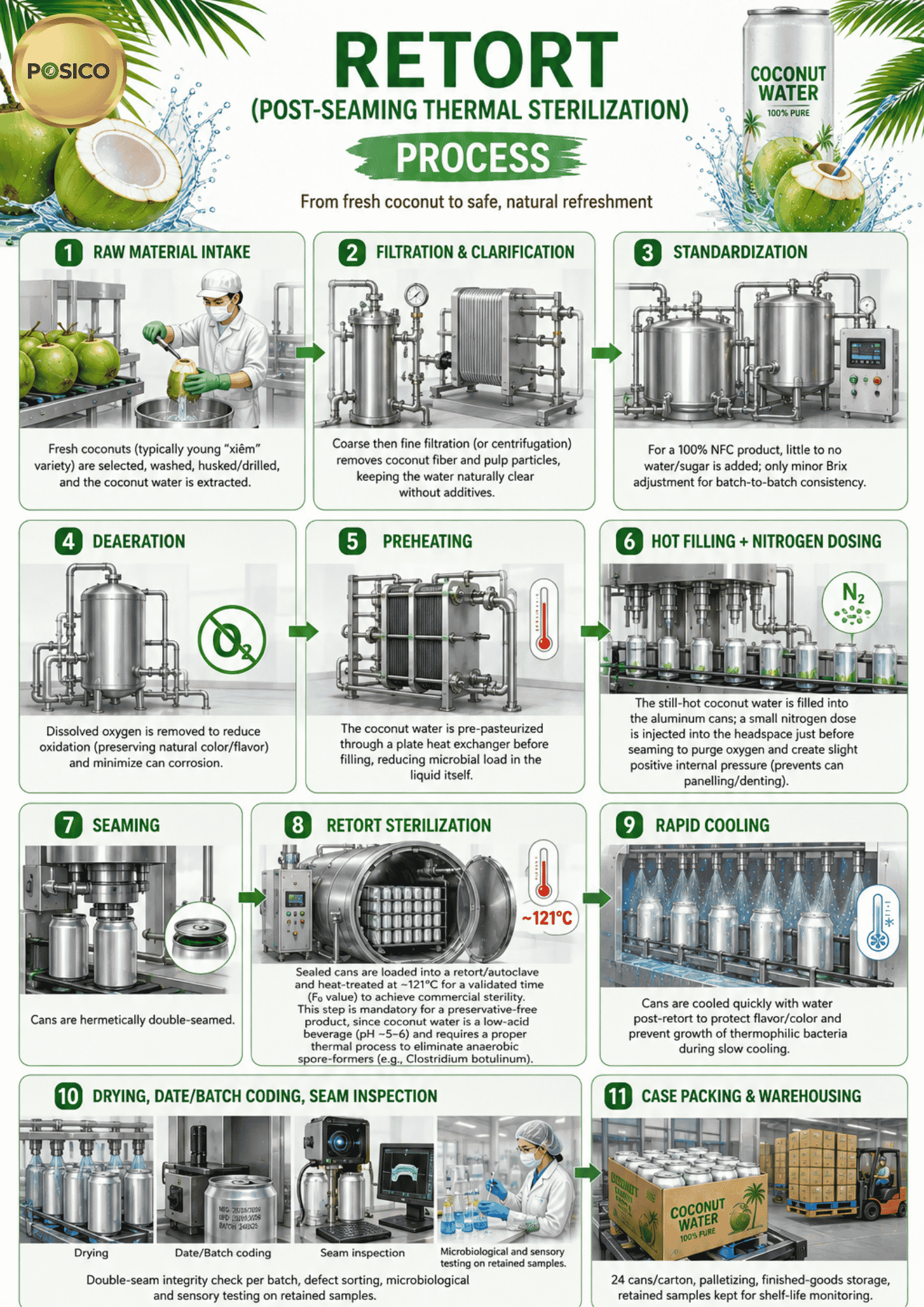
Our standard Retort Sterilization Process (post-seaming thermal sterilization):
1. Raw material intake — Fresh coconuts (typically young "xiêm" variety) are selected, washed, husked/drilled, and the coconut water is extracted.
2. Filtration & clarification — Coarse then fine filtration (or centrifugation) removes coconut fiber and pulp particles, keeping the water naturally clear without additives.
3. Standardization — For a 100% NFC product, little to no water/sugar is added; only minor Brix adjustment for batch-to-batch consistency.
4. Deaeration — Dissolved oxygen is removed to reduce oxidation (preserving natural color/flavor) and minimize can corrosion.
5. Preheating — The coconut water is pre-pasteurized through a plate heat exchanger before filling, reducing microbial load in the liquid itself.
6. Hot filling + nitrogen dosing — The still-hot coconut water is filled into the aluminum cans; a small nitrogen dose is injected into the headspace just before seaming to purge oxygen and create slight positive internal pressure (prevents can panelling/denting).
7. Seaming — Cans are hermetically double-seamed.
8. Retort sterilization — Sealed cans are loaded into a retort/autoclave and heat-treated at ~121°C for a validated time (F0 value) to achieve commercial sterility. This step is mandatory for a preservative-free product, since coconut water is a low-acid beverage (pH ~5–6) and requires a proper thermal process to eliminate anaerobic spore-formers (e.g., Clostridium botulinum).
9. Rapid cooling — Cans are cooled quickly with water post-retort to protect flavor/color and prevent growth of thermophilic bacteria during slow cooling.
10. Drying, date/batch coding, seam inspection — Double-seam integrity check per batch, defect sorting, microbiological and sensory testing on retained samples.
11. Case packing & warehousing — 24 cans/carton, palletizing, finished-goods storage, retained samples kept for shelf-life monitoring.